For nearly thirty years, I've done what most professional photographers do when traveling: packed a large camera body, several lenses, and enough equipment to handle almost any situation. The images were excellent, but there was one problem. I rarely enjoyed carrying it.
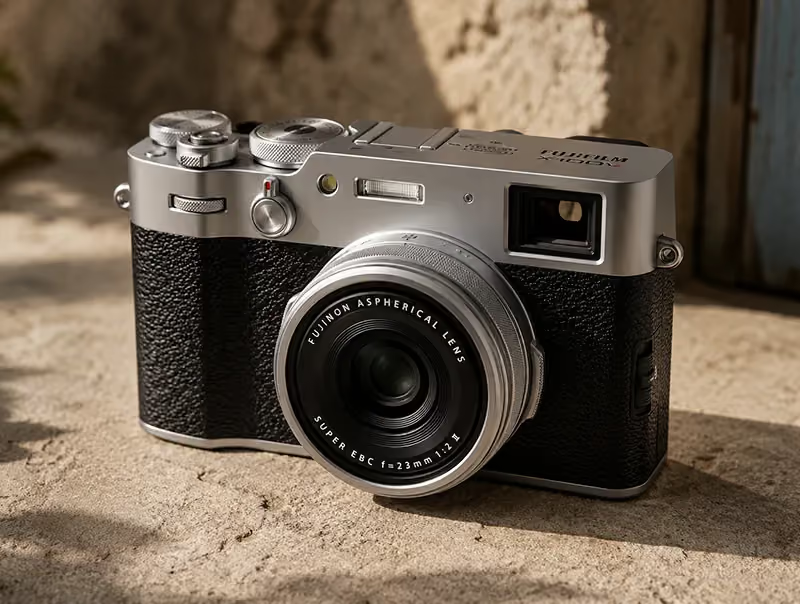
Before a recent trip to Arles, France, another photographer suggested I try something different. He described the Fuji X100VI as "the most fun camera I've ever owned." That was enough to convince me. Instead of taking my usual camera bag, I packed a single compact camera with one fixed lens and decided to live with whatever limitations came with it.
At first, those limitations felt exactly like that. The Fuji's 23mm lens (roughly the equivalent of a classic 35mm) is perfect for some photographs and completely wrong for others. Sure, the camera offers a digital crop, but that's not the same thing. I wanted to use the lens as it was designed, which meant if I wanted to get closer, I had to "zoom with my feet."
Oddly enough, I enjoyed that. A few years ago, I switched from an automatic transmission back to driving a manual. It wasn't because it was easier - it was because it made me a more active participant in the driving experience. The Fuji had the same effect. Instead of standing in one spot twisting a zoom ring, I found myself walking, exploring, and looking for different angles. I was more involved in making each photograph.
Somewhere during the week, something else changed: I stopped obsessing over camera settings. Like any new camera, there was a learning curve. I spent the first few days digging through menus, trying to make it behave like the Canon equipment I'd used for years. Eventually, I gave up. I stopped worrying about creating the "perfect" photograph every time and simply started paying attention to the world around me.
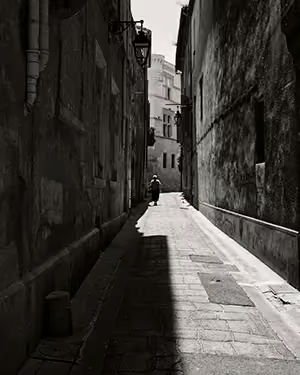
Instead of searching for subjects, I started searching for light. I noticed the way late afternoon sunlight wrapped around an old stone building. I watched shadows creep across narrow alleyways. I found myself constantly looking ahead, wondering what the next corner might reveal.
The camera had quietly changed the way I saw the city. It also changed the way the city saw me.
When you walk into a room carrying a professional camera with a large lens, everyone notices. People instinctively think, here comes a photographer. The moment you raise the camera, they're aware of it. Their expressions change. Their guard goes up.
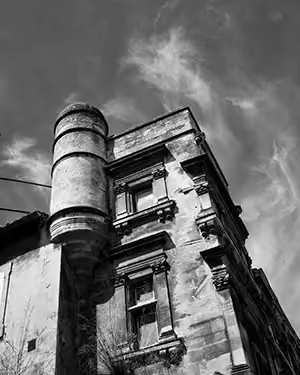
The Fuji had the opposite effect. Most people hardly noticed it hanging around my neck. I blended in as another traveler instead of standing out as the photographer. Many times I was able to raise the camera, capture a moment, and lower it again before anyone even realized I'd taken a picture. That alone changed the kinds of photographs I came home with.
When I returned from France and reviewed the images, they felt different from anything I'd created before - not necessarily better, just fresher. They reflected a slower, more observant way of working. In fact, the collection has since been selected for an exhibition in Plano next year.
Will I still use my Canon? Absolutely. When I'm photographing clients or teaching photography workshops, I'll gladly bring the larger camera and the lenses that help me do my job well.
But for travel? I can't imagine carrying anything other than that little Fuji.
It didn't replace my professional camera. It simply reminded me that creativity doesn't always come from having more choices. Sometimes it comes from having fewer.
For more about the Arles adventure:
I created an amazing portrait with the camera
Here is the story of the image
or